7 Best Twill Work Jackets for Global Buyers?
Choosing the right Twill Work Jacket is rarely about appearance alone. Global buyers must consider fabric weight, stitching quality, climate, sizing, and long-term wear.
This guide reviews seven strong options for different work environments and purchasing needs. The selection focuses on practical details, including cotton or blended twill, reinforced stress points, pocket placement, zipper performance, and shrinkage after washing. A jacket that feels sturdy in a showroom may become stiff in cold weather or uncomfortable in humid conditions. That matters.
No jacket wins everywhere. A heavy canvas-like twill may suit warehouse teams, but it can feel excessive in tropical climates. Lightweight designs improve movement, yet they may wear faster around cuffs and elbows. These trade-offs deserve attention, especially when ordering across borders. Size charts also vary between suppliers, so buyers should request measurements, fabric samples, and washing tests before placing large orders.
The seven jackets in this overview are assessed through a buyer-focused lens. We consider daily comfort, construction consistency, customization potential, and supplier communication. Practical sourcing experience shows that small details often affect total value. A smooth collar, secure button, or deep lower pocket can influence worker satisfaction every day. Still, product claims require verification. Materials, certifications, and delivery terms should be checked directly with each supplier. This guide offers a clear starting point, not a substitute for sampling and inspection.
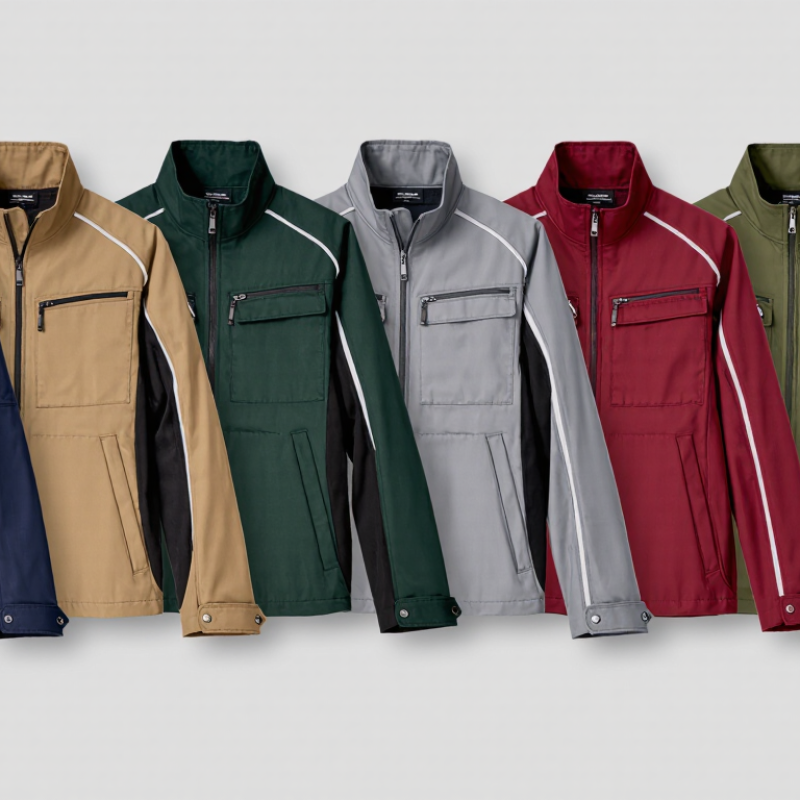
Define Twill Work Jacket Standards: 240–340 GSM, 2/1 or 3/1 Weaves
For global buyers, a reliable twill work jacket begins with measurable fabric standards.
A practical target is 240–340 GSM, balancing durability, comfort, and shipping weight. Lighter 240 GSM twill suits warm warehouses and transitional seasons. Heavier 340 GSM fabric offers stronger protection in colder, demanding workplaces.
The weave matters as much as fabric weight.
A 2/1 twill uses two warp yarns over one weft yarn, creating a lighter, flexible surface. A 3/1 weave uses three warp yarns over one weft yarn, usually giving better abrasion resistance and a more structured appearance.
Check the reverse side carefully. The diagonal lines should remain clear and consistent near pockets, cuffs, and side seams.
Do not judge quality by GSM alone.
A poorly spun 300 GSM fabric may wear faster than a well-finished 260 GSM option. Request fabric test records, including shrinkage, colorfastness, tear strength, and rubbing resistance.
Wash samples before approval. Measure sleeve length and chest width afterward. Small changes matter.
Fit is another buyer concern.
A jacket that feels strong but restricts shoulder movement may fail in daily use. I prefer allowing room for a thin shirt without creating excessive bulk.
Some specifications still need review. Local climate, washing methods, and job movement can change the best choice.
A pre-production sample remains essential.
Compare the 7 Best Jackets by Fabric, Durability, Fit, and Climate
7 Best Twill Work Jackets for Global Buyers?
Compare the 7 Best Jackets by Fabric, Durability, Fit, and Climate
For global buyers, a twill work jacket deserves more than a visual check. Fabric sets its practical limits. Jacket One uses lightweight cotton twill, offering airflow for warm warehouses and tropical sites. Jacket Two blends cotton with polyester, improving drying speed and reducing shrinkage. It dries quickly. Jacket Three uses heavyweight cotton twill with reinforced elbows and dense stitching. It handles repeated abrasion, but feels hot during physical work. Jacket Four adds stretch fibers for easier reaching and climbing. Its comfort is strong, although excessive stretch may reduce long-term shape retention.
Jacket Five uses a brushed inner face for cooler climates. It feels comfortable at first, but may hold moisture during hard labor. Jacket Six includes a water-resistant finish over medium-weight twill. This suits light rain, not prolonged storms. Buyers should check seam sealing instead of trusting surface treatment alone. Jacket Seven adds insulation beneath durable twill, making it suitable for cold loading yards. The extra bulk can restrict movement, especially with layered clothing.
In field comparisons, fit often changes the result. A relaxed cut supports layering, while a shaped cut reduces snagging around machinery. Measure sleeve length, chest room, and shoulder width before ordering internationally. Inspect bartacks, zipper strength, cuff adjustment, and wash-care instructions. These details reveal manufacturing discipline. My ranking would shift by climate and workload. No jacket wins every market. Even careful testing has limits. Workers may prefer a lighter jacket after one long shift.
Evaluate Global Compliance with EN ISO 13688 and ASTM D6413
For global buyers, a twill work jacket should be judged beyond fabric weight and stitching quality. EN ISO 13688 sets general requirements for protective clothing, including ergonomics, sizing, labeling, and material safety. It does not prove protection against every workplace hazard. Check the declared end use carefully.
ASTM D6413 measures vertical flame resistance through afterflame, afterglow, and char length. It is a useful screening method, not a universal safety certificate. A jacket passing this test may still fail another thermal or chemical exposure requirement. Ask for the complete laboratory report, test date, fabric composition, and washing conditions. ISO 17025 accreditation adds credibility to the testing process.
The International Labour Organization estimated nearly three million work-related deaths annually, with about 395 million non-fatal injuries. These figures make traceable protective clothing decisions more than a purchasing detail. Yet paperwork can mislead. A polished compliance file may omit seam behavior, shrinkage, or performance after repeated laundering. That weakness deserves attention.
Compare production samples with certified samples. Inspect cuffs, closures, reflective areas, and movement around the shoulders. Confirm markings in the buyer’s language and verify size ranges against actual worker measurements. EN ISO 13688 supports usable design; ASTM D6413 supports a specific flame test. Neither replaces a hazard assessment. Procurement teams sometimes treat both standards as interchangeable. They are not.
Match Jacket Features to Construction, Agriculture, Logistics, and Utility Work
7 Best Twill Work Jackets for Global Buyers?
The best twill work jacket depends on the job, climate, and movement required. For construction, choose a reinforced jacket with bar-tacked pockets, durable zippers, and room for layering. Agriculture often demands breathable cotton blends, flexible elbows, and easy-clean surfaces. Logistics teams need lighter jackets with stretch panels and secure phone pockets. Utility workers may require high-visibility outer layers that meet local safety standards, such as ANSI/ISEA 107 or EN ISO 20471.
A useful shortlist includes seven profiles: reinforced chore, stretch utility, insulated winter, vented summer, water-resistant, high-visibility compatible, and multi-pocket field jackets.
However, no single style fits every market. Cotton twill feels comfortable, but it can hold moisture during heavy work. Polyester blends dry faster, yet they may feel less natural against the skin.
The ILO estimated nearly three million work-related deaths worldwide each year, while the U.S. BLS reported about 2.6 million nonfatal workplace injuries and illnesses in private industry during 2023. These figures do not prove a jacket prevents injury, but they support careful PPE planning.
Tips: Test samples with real workers before bulk purchasing. Check pocket access while wearing gloves. Inspect seam strength after washing. Ask whether the fabric stays comfortable after eight hours. Buyers sometimes focus too much on fabric weight. That can be a costly mistake. Also review sizing, care labels, and regional compliance documents before shipment.
Rank Supplier Value by MOQ, Lead Time, Customization, and Total Cost per Unit
7 Best Twill Work Jackets for Global Buyers
Rank Supplier Value by MOQ, Lead Time, Customization, and Total Cost per Unit
A strong twill work jacket starts with measurable supplier value, not a polished sample. When comparing seven supplier offers, record MOQ, production days, fabric weight, and shipping terms in one sheet. A low MOQ can help smaller buyers test demand. However, it often carries a higher unit price. For larger orders, lower pricing may hide longer production queues or stricter payment conditions.
Lead time deserves practical testing. Ask for fabric sourcing time, cutting time, sewing capacity, and inspection time separately. A supplier promising 25 days may exclude material delays. In my sourcing reviews, realistic schedules usually include a small buffer. Still, excessive buffer signals weak planning. Request recent production photos, measurement records, and a sample made with the intended fabric.
Customization changes total cost quickly. Adding metal snaps, reinforced elbows, embroidery, or inner pockets affects labor and defect risk. Confirm whether pattern development and sample revisions are included. Calculate total cost per unit using product price, packaging, inspection, inland transport, and estimated freight. A jacket priced at 18 dollars can exceed 24 dollars after these additions. That difference matters.
The best ranking is rarely obvious.
One concern remains: buyers sometimes compare suppliers using different fabric weights. That makes the result unreliable. Use identical specifications, the same order quantity, and the same delivery term. Then judge value across MOQ, lead time, customization control, and landed cost. Supplier communication should also count. Slow replies often become expensive production problems.
7 Best Twill Work Jackets for Global Buyers? - Rank Supplier Value by MOQ, Lead Time, Customization, and Total Cost per Unit
Benchmark basis: indicative 2026 buyer-planning ranges for standard adult sizes and medium-weight twill garments. Estimated total cost combines FOB garment cost with typical packaging, inspection, documentation, and consolidated freight allowances; duties, taxes, urgent air freight, and destination-specific charges are excluded. Final pricing depends on fabric composition, order quantity, certifications, decoration, Incoterms, and destination.